

Arrived last night at the beautiful El-Ruha Hotel in Sanliurfa. It’s everything you would imagine an old Turkish hotel to be. Big, heavy, leather-and-cloth bound chairs and sofas in deep reds and greens, old wooden armoires, colorful Turkish rugs, views of ancient ruins that are illuminated at night. High ceilings, a whole extra sitting room, engraved drawer handles, elaborate, elderly chandeliers, unplanned and unnecessary cubic feet of space from an era before the the bean counters conquered hotel construction and life in general.
Staff are very sweet but a lot them don’t speak English. It took a while to communicate by translation app with a guy who came to help us figure out the air conditioning, which is essential in the dry, 100 degree heat. We’re in the southern part of Turkiye now, close to the Syrian border. Feels much lighter than Van, where we were very close to Iran.
Now it really feels like we’re in Turkiye, like being in a layer cake of ancient cultures and energies. Not quite timeless like the Nile, where it’s like you’re living in some kind of Atlantean/extraterrestrial time warp—a pre-verbal, unconscious, unworldly infancy of human-alien hybrids. Old Turkiye feels fully human, like we’re in our elementary school years rather than our infancy. There’s understandable communication with the past. It feels familiar and comprehensible. Warm and slow, more heart centered than modern adults tend to be, less mental, emotionally intense—like maybe a 10 to 12 year old.
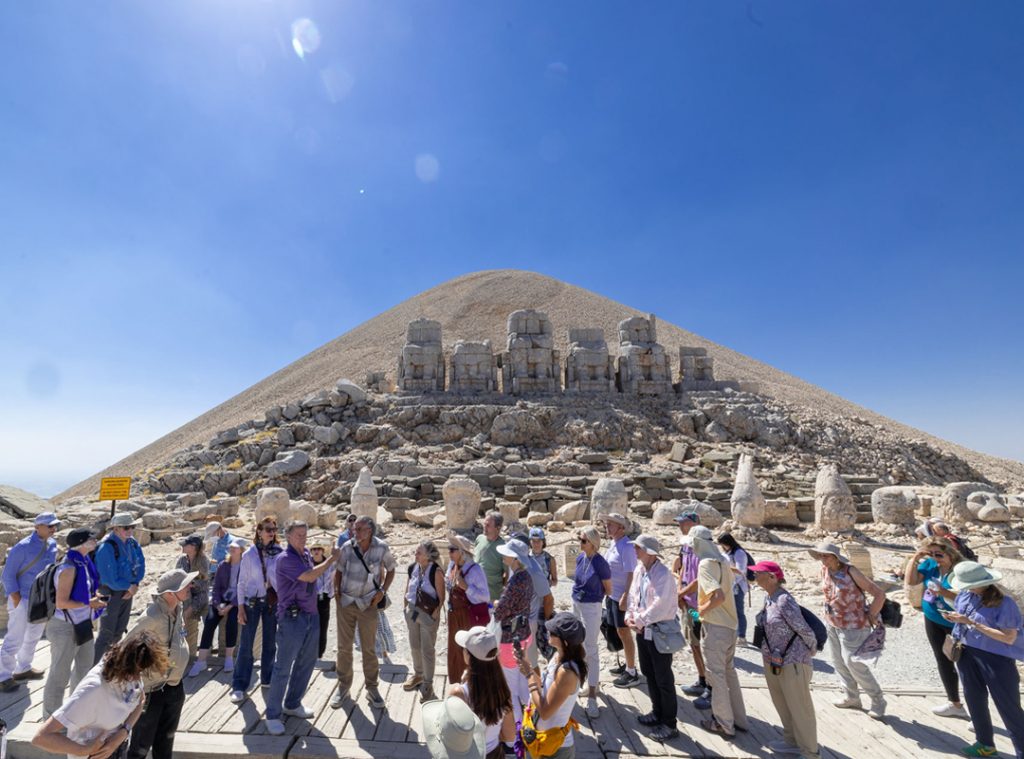
Today we visited Mt. Nimrod (or Mt. Nemrut). Large stone heads representing the different gods and animal deities of the ancient world have fallen to the ground from their seated bodies on the hilltop. It was built by King Antiochus in the first century B.C., and seems to be a combination of Hellenistic, Persian and Armenian traditions. Leigh mentioned to me that it seems as though Antiochus was trying to unite the various spiritual traditions in the region, and when I heard this the whole monument and its array of gods made perfect sense to me.
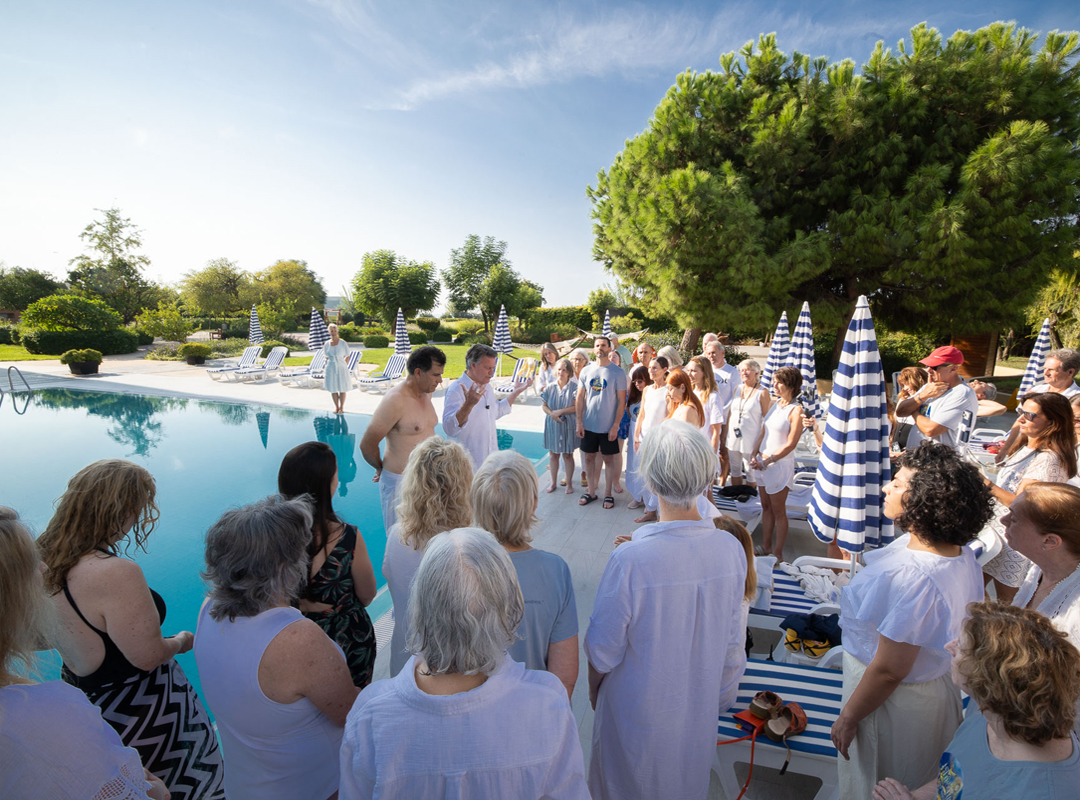
We ascended the 7000 foot peak of Mt. Nemrut in buses, then switched to vans when the road got too narrow, and then we were on foot for the last third of a mile or so. It was steep in parts, rocky, slippery, and a kind of pilgrimage where the journey was a cleansing and the effort insured that we were really committed to the process that would take place at the top. John gave a talk and blessing below the gigantic sculptures, and for me there was an energy of oneness, sourced in something very high in Spirit, which fits right into the idea that Antiochus’ intention was to bring the spiritual life of the area into a oneness with the one God by uniting the many gods.
The bus part of the journey was through Euphrates River area north of Antakya (Antioch), which was devastated by the 2023 earthquake. (You can see the rebuilding that’s been going on in some of the photos taken from our bus window.) After our climb of Mt. Nemrut we had lunch in the valley below, near the reservoir/lake created by Ataturk dam. And on our return we got another treat—a close conjunction of Venus and the crescent moon, reminiscent of Turkiye’s national flag.